
Foundations and Family Offices

Innovative finance is about designing capital to better serve people and the planet. It's a way of funding work that matters, using structures that actually fit the mission.
At its core, it challenges long-held assumptions about financial risk. It asks whether the current rules of funding reflect what impact-focused organisations actually need.
This page offers a quick overview of what innovative finance is, why it matters and how people are using it today.

Grants, venture capital and bank loans are the tools most commonly used to move money. But they weren't built with equity, sustainability or social impact in mind.
Innovative finance looks at the gaps in the system and builds new ways to fund what matters.
It's not about rejecting the old models. It's about designing better ones that work for more people, more outcomes and more types of organisations.
We believe innovative finance includes a wide array of approaches to managing capital and ultimately resourcing enterprises and interventions that create positive social and environmental outcomes.
Innovative Finance uses all the financial and philanthropic tools available. And when the right tool doesn't exist, it builds new ones.
Innovative finance covers a wide range of activity. It focuses on adapting how capital is structured, how incentives are set, and how financial processes actually work. Part of IFI's work is to map out the innovative finance space, so we expect this framework to evolve over time.
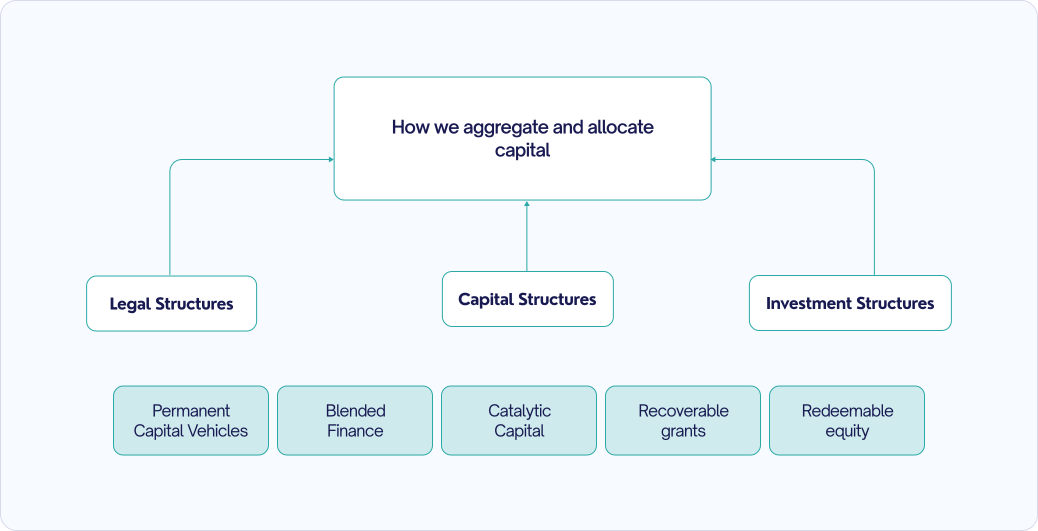
An investment or fund structure is the legal and organizational framework that determines how an investment vehicle is set up, operated, and regulated. It defines how assets are held, how investors participate, how returns are generated.
The marketplace of capital products has historically been dominated by a few traditional structures: venture capital, bank debt, and grants. These structures have been deployed by a handful of conventional legal structures, such as a closed-ended, GP/LP fund structure.
All over the globe, innovators are creating innovative structures that are better suited for driving impact and are fit-for-purpose for impact driven organisations. Let's break down some examples of innovative legal, capital and investment structures.
Investment Structures
Capital Structures
Capital structures refer to how different types of funding are layered and combined to meet the needs of both investors and enterprises. In the world of innovative finance, these structures are designed not just for financial return, but to unlock impact, reduce risk, and make deals work in contexts where conventional financing often fails. Here are two foundational capital structuring approaches widely used across the innovative finance ecosystem:
Legal Structures
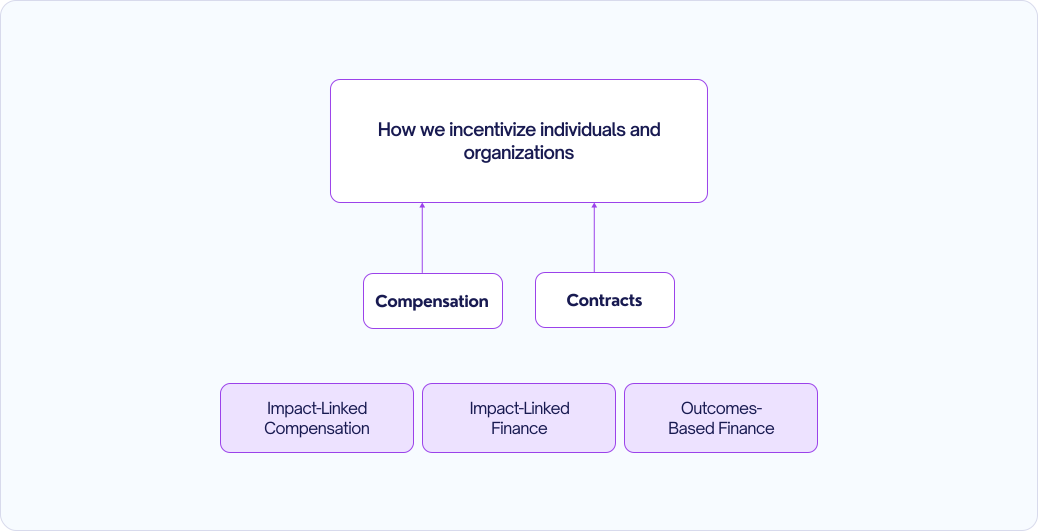
Incentives are the mechanisms or conditions that motivate decisions of participants in the financial markets. Incentives are fundamental to how the financial markets function and are designed to align interests, promote desired outcomes, or address inefficiencies.
Traditional finance has historically utilized specific structures that prioritize financial incentives when structuring and designing investment vehicles and products. Impact investing has attempted to measure and prioritize both financial and social/environmental incentives, but this has often been done using traditional investment tools and strategies.
Innovative finance includes mechanisms that rethink and redesign the structural incentives within an investment product or vehicle to formally align behavior and decision-making with desired impact outcomes. Examples include:
Compensation
Contracts
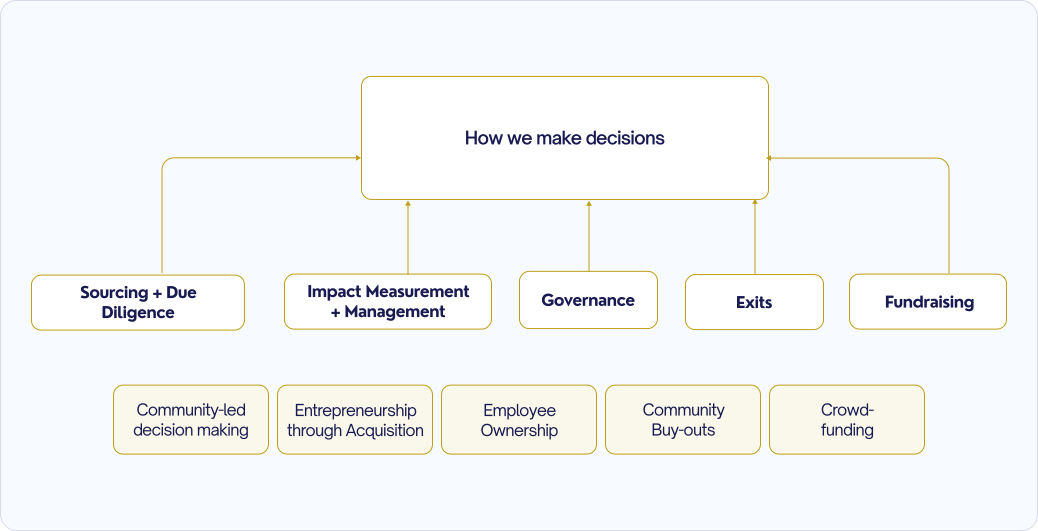
While there's no single dominant process across the financial industry, many traditional strategies have failed to prioritize inclusion, accountability, and long-term impact. At IFI, we highlight innovative strategies that shift how decisions are made, redistributing power, inviting new voices, and structuring decision-making to better align with community needs and systemic goals. Below are key decision points across the financial lifecycle, with examples of innovative approaches in each area:
Sourcing + Due Diligence
Impact Measurement + Management
Governance
Exits
Fundraising
Innovative finance isn't a niche. It's already in motion, with hundreds (maybe thousands?) of people experimenting and building across sectors.
That includes:


What they have in common is a willingness to question old assumptions and build what's needed instead.
Apis & Heritage Capital Partners focuses on converting privately-held companies with large workforces of colour into 100% employee-owned businesses through their Employee-Led Buyout (ELBO) model, aiming to close the racial wealth gap and empower workers.
Read MoreNovel provides up to $5 million in non-dilutive, revenue-based funding to founders. Revenue-based financing is a model where investors provide capital to a business in exchange for a percentage of the company's future revenue, rather than fixed payments or equity dilution.
Read MorePrime Coalition ties financial incentives (in the form of carry) to measurable outcomes, using a mission lock criteria governed by a mission alignment committee that is also composed of external members and experts on impact.
Read MoreMaycomb's fund utilizes outcomes-based finance to align government spending with evidence-based solutions to social challenges by providing flexible, mission-aligned debt to finance high-impact services and measuring outcomes to determine the amount of "outcome payments" earned.
Illumen Capital is a fund-of-funds that invests in emerging venture fund managers and aims to reduce racial and gender bias in investing. They have developed a specific "bias reduction due diligence process" as part of their approach to investing in emerging managers.
Unlock Ownership is a multi-donor fund that uses grants, equity and debt to invest in funds or projects focused on wealth building through asset ownership. All grant and investment decisions are made by an inclusive governance committee, made up of experts, asset allocators, fund managers in the portfolio, and the fund founders.
The Innovative Finance Initiative is a time-bound effort to support the work of reimagining how capital flows.
We are focused on learning, exploring and building together through connectivity events, collaborative learning and shared resources.
Whether you're new to this space or already experimenting, there's room to learn more, ask questions and share what you're working on.